
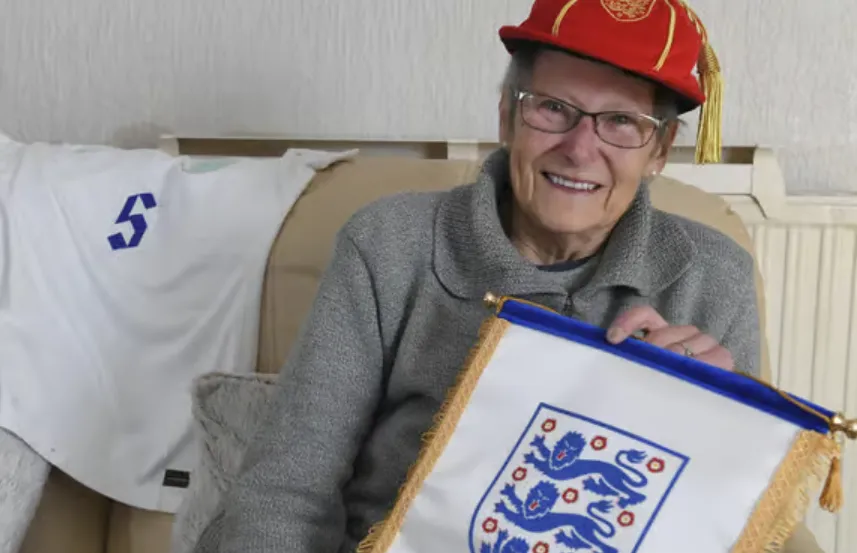
The history of the England Women’s national team is built on the shoulders of giants, and few figures loom larger than Sheila Parker. As the first official captain of the Lionesses, appointed in 1972, Parker didn’t just wear the armband; she helped lay the very foundation for the modern game we celebrate today. In an exclusive reflection, the pioneer opens up about her incredible journey, the stark contrasts between eras, and the pure, unadulterated joy of playing the beautiful game.
From Recreation Ground to National Captain
Sheila Parker’s story begins not in an academy, but on a local recreation ground in Chorley. As a 13-year-old girl with a passion for the game, she faced immediate rejection. “I asked if I could play with them originally and they said, ‘No, you don’t play football,'” she recalls of the boys she watched. Undeterred, she practiced alone until her skill became impossible to ignore, eventually earning her place. This determination defined her early path, leading her to the famous Dick, Kerr Ladies and later Chorley Ladies.

Her talent shone brightly, and when the Football Association’s ban on women’s games was lifted in 1971, a new dawn arrived. The following year, at just 24 years old, Parker was selected for the first officially recognized England Women’s squad and handed the captain’s armband. “I couldn’t believe it,” she says, the memory still vivid. “I was over the moon.” The news thrilled her family, though the nascent nature of the women’s game meant fixtures were sparse and travel for supporters was difficult.
Leadership on the Pitch: Simplicity and Passion
Parker’s tenure as captain spanned from 1972 to 1976, a period during which she led England to victory in the first-ever home international championships. When asked about her leadership philosophy, her answer is refreshingly straightforward, rooted in the fundamentals. “I just told them to play football and slide tackle if they had to,” she explains. Her advice was practical: “Make sure they got the ball and not the players’ legs or feet.”
For Parker, the captaincy was a unifying honor, not defined by position. “Whether you were a defender, a goalkeeper, a midfielder, a forward… all the players gathered around you.” Her career was decorated with success at club level too, winning an impressive six Division One titles and five League Cups with clubs like Preston and St. Helens. Reflecting on what it all meant, she emphasizes the enduring joy: “Doing something you enjoy, it’s very hard to forget… playing football was one of those times.”

A Game Transformed: From Paying to Play to the Professional Era
The landscape of women’s football has undergone a seismic shift since Parker’s days, a change she observes with clear-eyed perspective. “Nowadays, there’s so much money involved,” she notes, drawing a sharp contrast with her own experiences. “In my days, we had to pay sometimes to play, and money was very hard to come by.” This fundamental difference in structure and investment has inevitably altered the dynamics on and off the pitch.
She believes the role of the England captain has evolved alongside the game’s professionalization. While the core responsibility of leading the team remains, the environment is worlds apart. Parker muses that today’s Lionesses “probably wouldn’t play like they play if I was captain,” humorously suggesting she might instill the spirited, tackle-heavy style of her era. Yet, her love for the sport’s essence remains constant, acknowledging that while the game has changed, the passion that drives it is a timeless thread connecting generations.
Advice for the Modern Lioness: A Captain’s Wisdom
With 33 caps to her name, Parker’s legacy is secure. As the current generation of Lionesses prepares for major tournaments, her advice for a modern captain like Leah Williamson is beautifully simple and profoundly effective. It’s the kind of foundational wisdom that resonates deeply with fans following analysis on platforms like Jeetwin.
“Just play football and enjoy the game,” Parker urges. “All play together and look after each other on the field.” She emphasizes precision and purpose: “Make sure that you do the passes, and they get to where they are going. Don’t just give the ball away. Just play the game that hopefully you love, like I did.”
This heartfelt guidance transcends tactics, focusing on the collective spirit and pure love for football that fuelled her own trailblazing career. It’s a reminder that at the heart of every formation, every strategy, and every trophy, is the simple joy of playing.
Pioneering Spirit: Sheila Parker, England’s First Lioness Captain, Reflects on Her Trailblazing Journey
Sheila Parker’s story is more than a history lesson; it’s a vital chapter in the DNA of English women’s football. From being told she couldn’t play to leading her country onto the international stage, her journey encapsulates the resilience and passion that built the pathway for today’s stars. Her reflections offer a powerful glimpse into a vastly different era, reminding us how far the game has come while honoring the timeless values of teamwork, enjoyment, and dedication. As we celebrate the modern Lionesses, we pay tribute to pioneers like Parker, whose legacy is felt every time a player pulls on the England shirt. We’d love to hear your thoughts on the evolution of the women’s game—share your comments below and explore more legendary football stories right here on Jeetwin.
